Protection can interrupt conversation
Removing headphones may restore speech, but it can also restore the background sound the wearer is trying to manage.
An upcoming local voice-intercom proof of concept for people who want to keep noise-cancelling or isolating headphones on while speaking with trusted people nearby.
Early-stage work. HearMe is not currently offered as a public service or safety-critical communication system.
For some people, reducing environmental sound is an important part of travelling, working or taking part in busy places. In a 2025 study of autistic adults, 73.5% of autistic participants reported using earplugs or headphones to manage sound environments.
Removing headphones may restore speech, but it can also restore the background sound the wearer is trying to manage.
Transparency features can be useful, yet they do not create a private channel for selected companions.
Messaging or internet calls can work, but they add screens, accounts or connectivity to a conversation happening only a few feet away.
The PoC will bring a small set of local intercom controls into an Android app so the complete experience can be tested with participants, devices and realistic background noise.
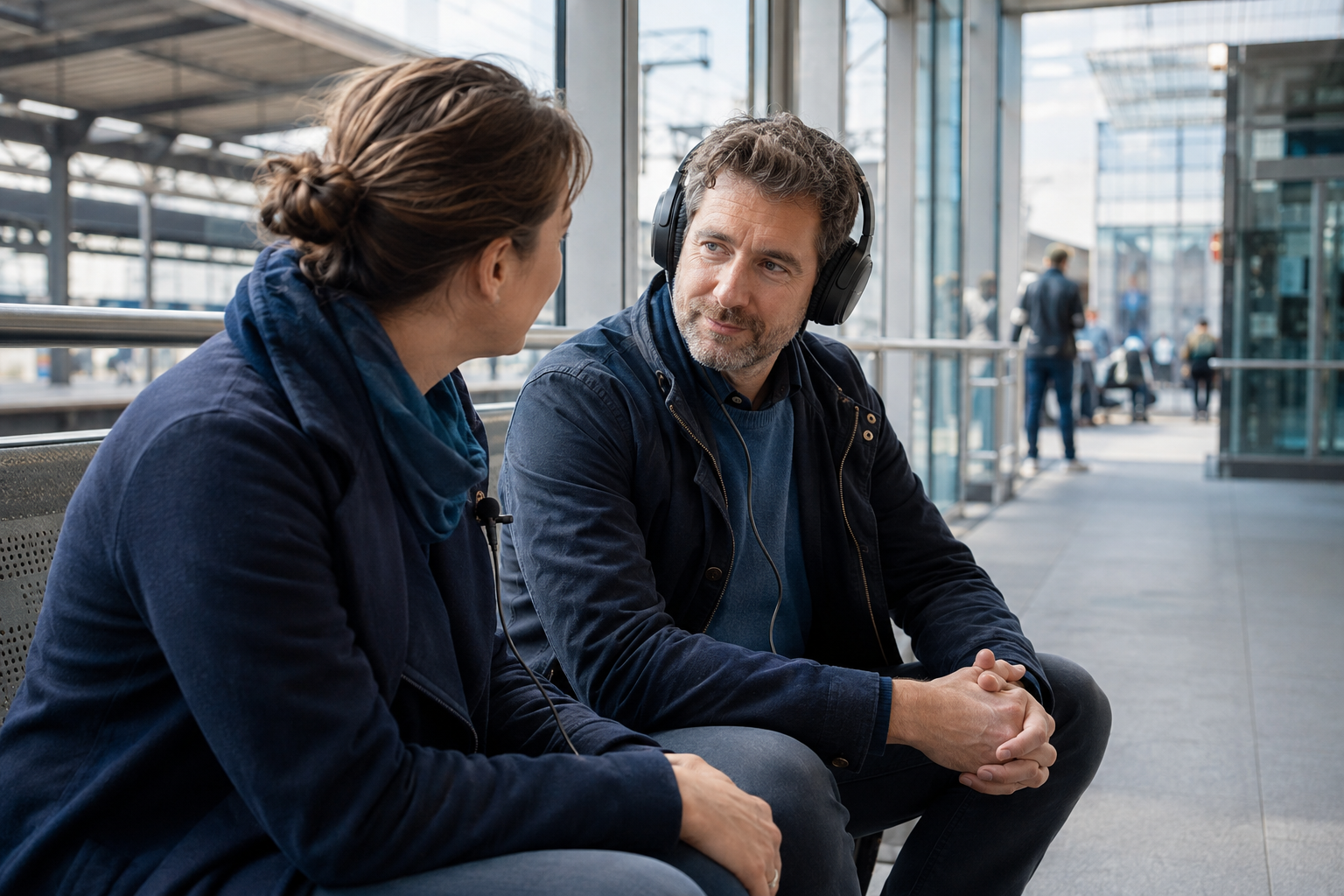
A host starts a short-lived session for nearby participants on the same Wi-Fi or hotspot.
Participants use a QR code or manual local-network details rather than creating an account.
The PoC will test natural two-way conversation rather than a turn-by-turn walkie-talkie exchange.
Each listener receives the other active voices without hearing a delayed copy of their own speech.
Mute, push-to-talk and voice-activity options let participants choose when their microphone transmits.
Route and network indicators help the pilot identify latency, packet loss and unsuitable microphone paths.
The alpha uses a host-mixed star arrangement: one Android device coordinates a private local session and prepares a separate output for each participant.
01 / Participant
A wired, USB or built-in microphone captures speech in short audio frames under the participant's mute or voice-activity settings.
02 / Local network
Audio stays on the shared Wi-Fi or hotspot while the host aligns active streams and creates a mix for each listener.
03 / Listener
The listener hears the selected nearby voices through their chosen headphones, excluding their own delayed voice.
The initial alpha uses uncompressed speech frames to prioritise a working local test. A later transport could use Opus once the core experience is reliable.
The pilot should test a useful communication route without obscuring device limits, environmental risk or the difference between an early prototype and an established service.
No accounts, cloud backend or audio recording are planned for the alpha. Session state and audio buffers remain temporary.
Wired or USB microphones are preferred because Bluetooth Classic headset microphones can reduce speech quality.
Wired output is the baseline for low-latency testing. Bluetooth output may be useful, but its delay must be assessed on real devices.
The PoC does not replace alarms, announcements, traffic awareness or any situation where surrounding hazards must be heard.
HearMe is not a medical device, hearing protection product, emergency service or substitute for professional advice.
Accessibility value, reliability, battery use and user acceptance will be measured rather than assumed.
The purpose of the PoC is to learn whether the idea improves real nearby conversations, where it adds friction, and what a responsible next stage would require.
Can a new participant move from installed app to joined session in under two minutes without specialist support?
Are speech clarity and delay comfortable enough for natural conversation with wired and Bluetooth outputs?
Can two people sustain a ten-minute exchange, and can the same design support four participants without crashes or loss of intelligibility?
Does the approach reduce sensory load without creating new discomfort, stigma or distraction?
Which microphones, headphones and controls are acceptable, and are the limits understood in each test setting?
HearMe needs practical challenge, participant insight and careful measurement alongside technical delivery. We welcome partners who can help define a useful, proportionate test.
Funders
Support discovery, accessible participation, equipment, technical delivery and independent evaluation.
Accessibility organisations
Help frame real needs, inclusive recruitment, safeguards and meaningful measures of value.
Android and audio specialists
Bring mobile audio, networking, assistive technology, device testing and field reliability experience.
Participants and pilot settings
Test the proposition in realistic travel, workplace, event and public-space conditions.
If your organisation can fund, challenge, strengthen or participate in the HearMe PoC, we would welcome a focused conversation.